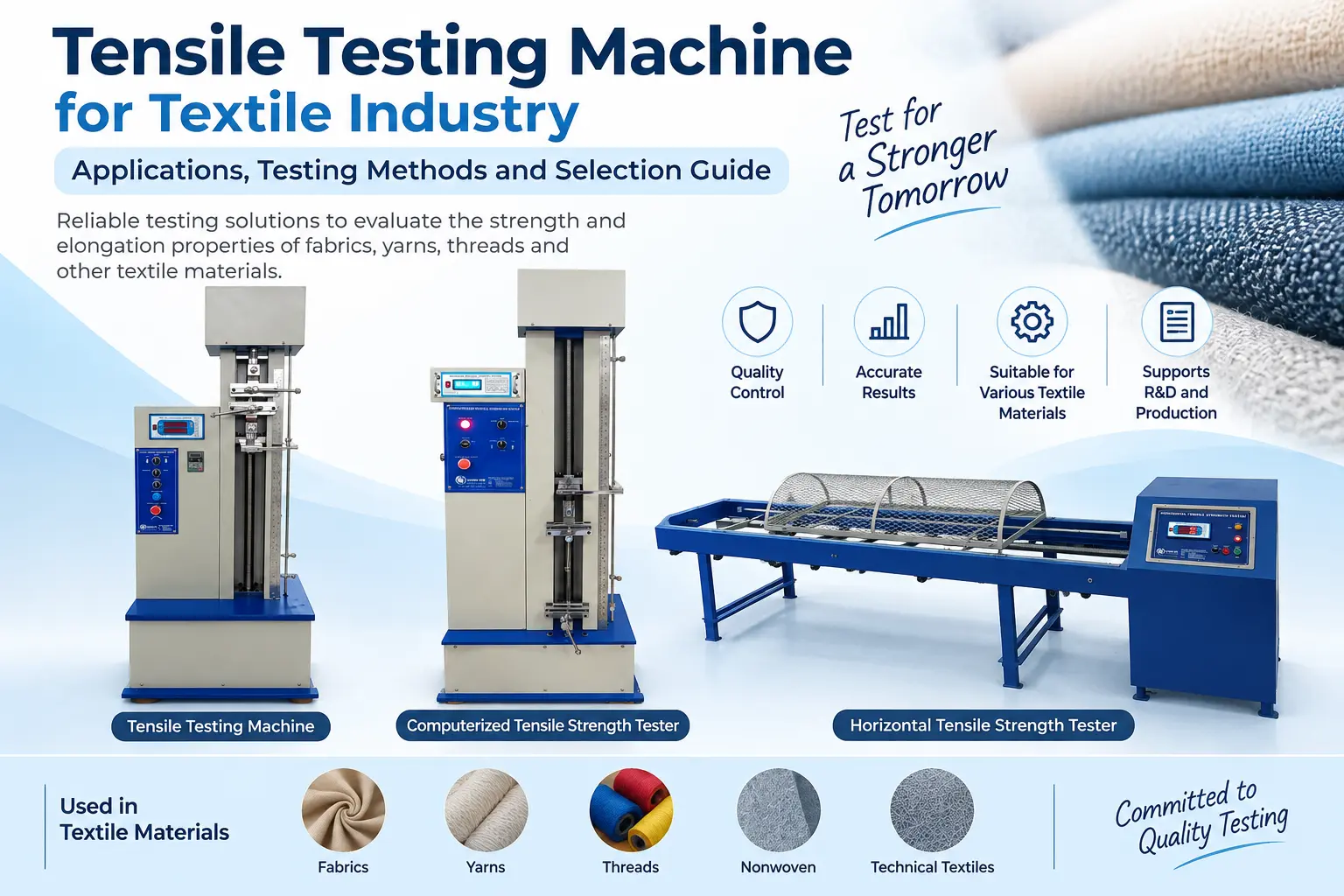
A Tensile Testing Machine for Textile Industry is used to evaluate the tensile properties of fabrics, yarns, threads and other textile materials. Textile materials are subjected to different types of forces during manufacturing, processing and end use.
Textile materials are subjected to different types of forces during manufacturing, processing and end use. Fabrics, yarns, threads and other textile components need sufficient strength and elongation properties for their intended applications. Tensile testing is one of the commonly used methods for evaluating these mechanical properties.
A Tensile Testing Machine for Textile Industry is used to apply a controlled pulling force to a textile specimen and measure its response until a specified point or breaking point is reached. The test can provide information such as tensile strength, breaking force and elongation, depending on the test method and material being evaluated.
This article explains the role of tensile testing machines in the textile industry, their working principle, common applications and important factors to consider when selecting a machine for a textile testing laboratory.
What is a Tensile Testing Machine?
A tensile testing machine is a testing instrument designed to measure the resistance of a material when it is subjected to a controlled tensile force. During the test, a specimen is held between suitable grips and pulled at a predetermined rate.
The machine records the force applied to the specimen and, depending on the testing system, the corresponding extension or elongation. These measurements help laboratories evaluate the tensile behaviour of textile materials.
In textile testing, tensile testing machines may be used for evaluating:
- Woven and knitted fabrics
- Yarn
- Sewing threads
- Nonwoven materials
- Geotextiles
- Technical textiles
- Coated and laminated textile materials
The machine configuration, grips, load capacity and testing parameters should be selected according to the material and applicable test method.
Why is Tensile Testing Important in the Textile Industry?
Tensile properties are important because textile materials experience pulling forces at different stages of their lifecycle.
For example, a fabric may be subjected to tension during weaving, stitching, garment manufacturing and regular use. Yarn and thread are also exposed to tensile forces during processing and sewing.
Tensile testing can help manufacturers and laboratories evaluate whether a material meets the required mechanical performance for its intended application.
The test may be used for:
- Quality control of incoming raw materials
- Monitoring production consistency
- Comparing different textile materials
- Product development and research
- Evaluating changes in material properties
- Verifying compliance with applicable test specifications
The results obtained from tensile testing should always be interpreted according to the relevant test method, specimen preparation and material requirements.
How Does a Tensile Testing Machine Work?
The basic working principle of a tensile testing machine involves applying a controlled pulling force to a specimen.
A typical test generally follows these steps:
1. Specimen Preparation
The textile sample is prepared according to the selected testing method. The dimensions, direction and number of specimens can affect the test results.
2. Mounting the Specimen
The specimen is placed between appropriate grips or clamps. Proper gripping is important to reduce slippage or damage to the sample during testing.
3. Applying Tensile Force
The machine applies a controlled tensile force at the specified testing speed or rate.
4. Measuring the Response
During the test, the machine measures the force applied to the specimen. The testing system may also record extension or elongation.
5. Evaluating the Results
The recorded data can be used to determine properties such as maximum force, breaking force, tensile strength or elongation, depending on the applicable test procedure.
Important Properties Evaluated During Textile Tensile Testing
Different tensile tests may evaluate different mechanical properties. Some commonly measured parameters include:
Tensile Strength
Tensile strength indicates the ability of a material to resist a pulling force. The calculation and reporting method can vary depending on the test standard and specimen dimensions.
Breaking Force
Breaking force refers to the force recorded when the specimen breaks during the test.
Elongation
Elongation indicates the amount of extension experienced by the specimen when subjected to tensile force. It is often expressed as a percentage of the original gauge length.
Maximum Force
Maximum force is the highest force recorded during the tensile test.
These values can be useful for comparing materials and monitoring consistency when testing conditions are maintained.
Applications of Tensile Testing Machines in Textile Testing
Tensile testing machines can be used for different types of textile materials and applications.
Fabric Tensile Testing
Fabric testing may involve evaluating the tensile behaviour of woven, knitted or nonwoven materials.
Depending on the test method, testing may be performed in different directions, such as:
- Warp direction
- Weft direction
- Machine direction
- Cross direction
The results can help evaluate the strength and elongation characteristics of the fabric.
Yarn Tensile Testing
Yarn tensile testing is used to evaluate the breaking force and elongation characteristics of yarn.
The test can be useful during yarn production and quality control, as variations in yarn properties may affect further textile processing.
Sewing Thread Testing
Sewing threads are subjected to tensile forces during stitching and garment production.
Tensile testing can be used to evaluate the breaking force and elongation behaviour of sewing threads under controlled testing conditions.
Nonwoven Material Testing
Nonwoven materials are used in applications such as hygiene products, medical textiles, filtration and industrial products.
Tensile testing can help evaluate their mechanical properties in different directions according to the required application and test method.
Technical Textile Testing
Technical textiles used in industrial and specialised applications may require controlled mechanical testing.
Depending on the material, tensile testing may be used for evaluating coated fabrics, geotextiles, reinforcement materials and other technical textile products.
Factors That Can Affect Textile Tensile Test Results
Tensile test results can be influenced by several factors. For meaningful and repeatable results, laboratories should control the testing conditions and follow the selected test procedure.
Important factors include:
- Specimen size and preparation
- Direction of the fabric
- Gauge length
- Test speed
- Type of grips used
- Specimen conditioning
- Load capacity and measurement range
- Operator handling
- Applicable test method
Even small variations in specimen preparation or testing parameters can affect the results, particularly when comparing different batches or laboratories.
How to Choose a Tensile Testing Machine for Textile Industry
Selecting the right tensile testing machine depends on the type of textile materials being tested and the requirements of the laboratory.When selecting a Tensile Testing Machine for Textile Industry, laboratories should consider the type of material, expected load range, suitable grips and applicable testing requirements.
Load Capacity
The machine should have an appropriate load capacity for the expected force range of the materials being tested. Selecting an excessively high or low range may not be suitable for all testing applications.
Suitable Grips
Different textile materials may require different types of grips.
For example, fabric, yarn and thread specimens may require suitable gripping arrangements to reduce slippage or specimen damage during testing.
Test Speed Control
The ability to control the test speed is important when testing according to a specified procedure.
Measurement Accuracy
The accuracy and resolution of the load measurement system should be suitable for the required testing range.
Software and Data Recording
Depending on laboratory requirements, the testing system may include software for recording and analysing test data.
Data recording can help laboratories maintain test records and compare results from different samples or production batches.
Applicable Test Methods
Before selecting a machine, laboratories should identify the test methods or specifications relevant to their products.
The required machine configuration may vary depending on specimen dimensions, load requirements, grips and testing parameters.
Benefits of Using a Tensile Testing Machine in Textile Quality Control
When used with a suitable test method, a tensile testing machine can support textile quality control activities.
A suitable Tensile Testing Machine for Textile Industry can help support routine quality control, material comparison and product development activities.
Some practical benefits include:
- Evaluating the mechanical properties of textile materials
- Monitoring production consistency
- Comparing different material samples
- Supporting product development activities
- Identifying variations between batches
- Maintaining documented test records
The usefulness of the results depends on proper specimen preparation, machine configuration and adherence to the relevant testing procedure.
Importance of Proper Machine Maintenance and Calibration
Regular maintenance and calibration are important for maintaining confidence in testing results.
Laboratories should inspect components such as grips, load measurement systems and moving mechanisms according to their maintenance procedures.
Selecting the right Tensile Testing Machine for Textile Industry depends on the materials being tested, the required load range and the applicable testing procedure.
Calibration should be carried out according to laboratory requirements and applicable quality systems.
Regular checks can also help identify issues such as specimen slippage, grip wear or variations in measurement performance.
Tensile Testing Machine for Textile Laboratories
A tensile testing machine can be an important instrument for textile manufacturers, testing laboratories and research facilities involved in evaluating fabric, yarn, thread and other textile materials.
The most suitable machine depends on the type of specimen, expected load range, test method and laboratory requirements.
Before selecting a system, it is useful to clearly define the materials to be tested and the properties that need to be measured. This helps in selecting the appropriate load capacity, grips, test speed range and data recording options.
For textile manufacturers and laboratories, consistent testing procedures and properly maintained equipment can help generate comparable data for quality control and material evaluation.
Frequently Asked Questions
What is a tensile testing machine used for in the textile industry?
A tensile testing machine is used to evaluate the response of textile materials when subjected to a controlled pulling force. Depending on the test method, it can be used to measure properties such as breaking force, tensile strength and elongation.
Which textile materials can be tested using a tensile testing machine?
Depending on the machine configuration and grips, tensile testing may be performed on fabrics, yarns, sewing threads, nonwoven materials, technical textiles and other textile products.
Why is elongation important in textile testing?
Elongation provides information about how much a textile specimen extends when subjected to tensile force. It can be relevant when evaluating the mechanical behaviour of materials used in different textile applications.
What should be considered when selecting a tensile testing machine?
Important considerations include the type of material, expected load range, suitable grips, testing speed, measurement requirements, data recording requirements and applicable test methods.
Can the same tensile testing machine be used for different textile materials?
In many cases, a tensile testing machine may be configured for different materials using suitable grips, load ranges and testing parameters. The suitability depends on the specific machine and testing requirements.
Conclusion
Tensile testing plays an important role in evaluating the mechanical behaviour of textile materials. By applying a controlled tensile force, a tensile testing machine can provide data related to properties such as breaking force, tensile strength and elongation.
For textile manufacturers and testing laboratories, the value of tensile testing depends not only on the machine but also on proper specimen preparation, suitable grips, controlled test parameters and the use of an appropriate testing method.
When selecting a tensile testing machine for textile applications, laboratories should consider the materials they test, expected load requirements and the testing procedures they need to follow. A suitable testing setup can support regular quality control, material comparison and product development activities.
Digital Tensile Strength Tester https://globetexindustries.com/product/digital-tensile-strength-tester/