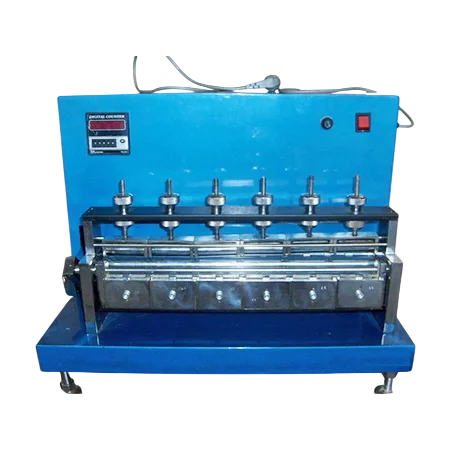
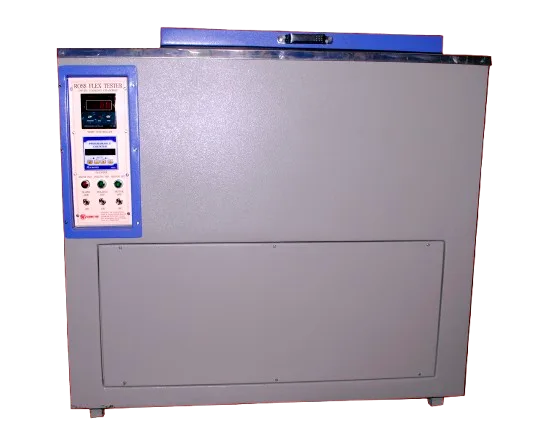
ROSS FLEX TESTER WITH COOLING CHAMBER
The ability of any shoe sole to with stand repeated bending experienced during walking without developing a crack within the estimated life span of the shoe is a very important factor for determining its quality. Also, its ability to withstand propagation of any slit formed due to a sharp edge or pointed object piercing it during walking is equally important in assessing its quality. These abilities of any sole can be evaluated with the help of a Ross Flex Tester.
 Chat on WhatsApp
Description
| Specification | Details |
|---|---|
| Model No. | GTX-LR6 |
| Dimensions of Test Specimen | 150 × 25 × 6.3 mm |
| Number of Test Specimens | 12 Specimens Simultaneously |
| Angle of Bending of Specimen | 90° |
| Radius of Bend | 5 mm |
| Frequency of Flexing | 1 ± 0.1 Hz (60 ± 6 Cycles/Minute) |
| Width of Slit | 2.0 mm |
| Distance of Slit from Fixed End | 62 mm |
| Test Temperature | Up to -10°C |
| Motor | ¼ HP, Single Phase, 230V AC |
Features:
- Digital preset counter incorporated for accuracy and repeatability.
- Robust construction with rigid metallic base.
- Aesthetically designed using heavy metal guide rods.
- Ease of use of sample placement with dynamic flexing fixtures.
- Fully automatic test cycle through digital preset cyclic counter.
- Strong gripping system to hold samples in the same vertical plane.
Cooling Chamber:
| Specification | Details |
|---|---|
| Construction | Double Wall, Double Door Inner Chamber of SS and Outer Body of MS Powder Coated |
| Application | Suitable to Accommodate Ross Flex Tester and Perform Testing Inside Chamber |
| Temperature Range | -20°C |
| Accuracy | ±1°C |
Related Standards:
- IS 15298 (Part 2) – 2011 : Method to Determine Flexing Resistance.
- ISO 8782-1 : 1998 – Safety, Protective and Occupational Footwear for Professional Use.
- IS 3400 (Part 16) – 1974 : Methods of Test for Vulcanized Rubbers.
Note:
- Extra for Specimen Cutting Die.