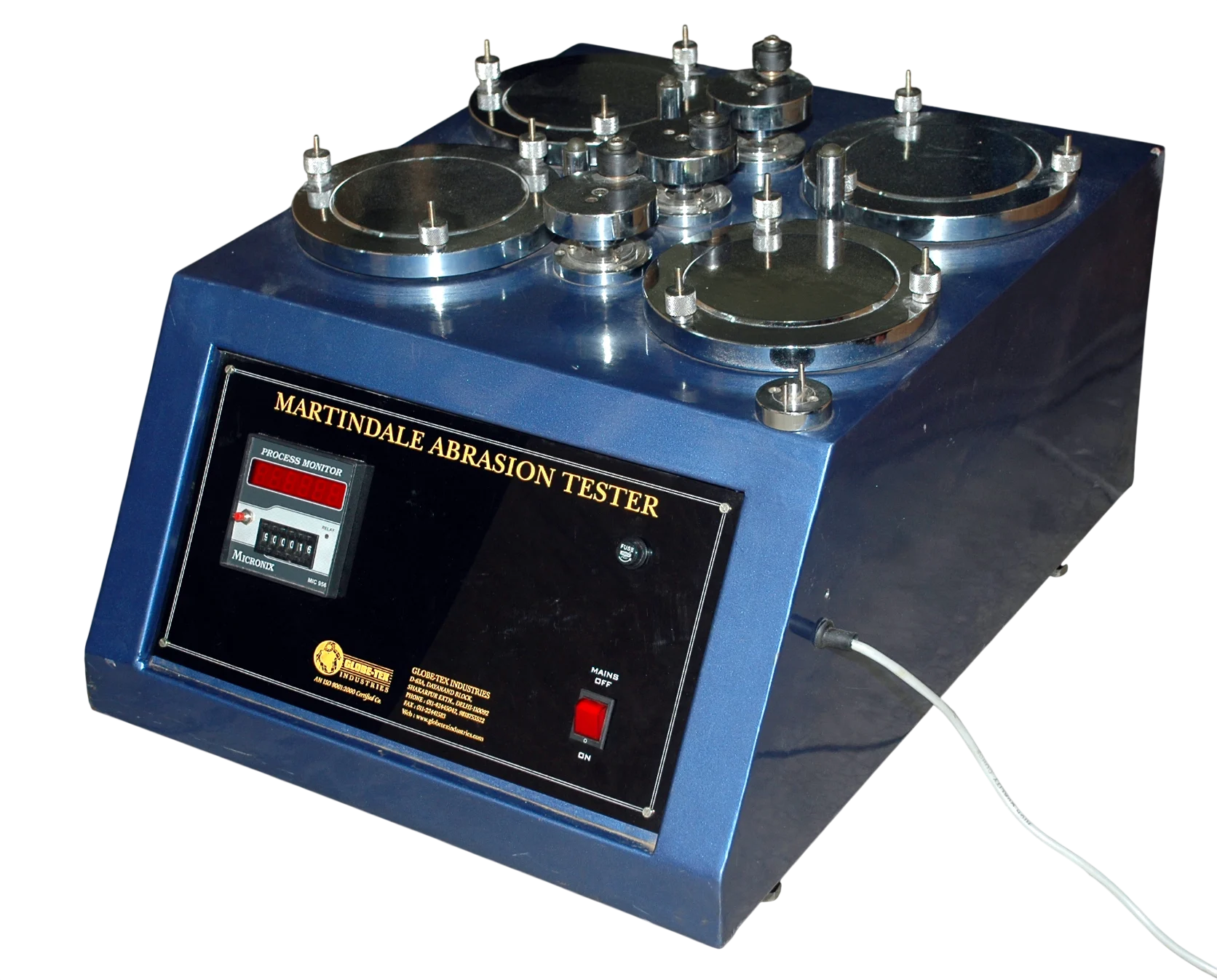
MARTINDALE ABRASION CUM PILLING TESTER
To determine the resistance to pilling and surface change of the textile fabric, abrasion test is to be conducted on the fabrics under test. Determination of resistance of any fabric to abrasion is usually carried out by abrading the fabric under specified conditions against a standard abradant. Although plane abrasion of fabric surface does not cover all aspects of strains that are important in determining service life, there are occasions when such a test gives useful information. With 4 nos. circular abrasion tables circular specimen of fabric are abraded under known pressure under a motion which is the resultant of too simple harmonic motion at right angle to each other the resistance of abrasion is estimated by visual appearance or by finding the loss in mass of the specimen.
 Chat on WhatsApp
Description
| Specification | Details |
|---|---|
| Model No. | GTX-LN7 |
| Maximum Number of Test Specimens | 4 |
| Speed of Outer Pegs | 47.5 ± 2 RPM |
| Ratio of Speeds of Outer Pegs to Centre Peg | 32 : 30 |
| Stroke of Pegs | 60.5 mm |
| Face Area of Specimen Holder | 6.45 cm² (28.65 mm Diameter) |
| Pressure on Test Specimens | 3, 6, 9 and 12 KN/m² |
| Maximum Load | 790 g (Corresponding to Pressure of 12 KN/m²) |
Related Standards:
- IS 12673:1989 – Textile Fabrics: Abrasion Resistance – Methods for Determination.
- BS Handbook 1 – Method of Test for Abrasion Resistance of Fabrics.
- IS 15298 (Part-2):2011.
- ISO 8782-1:1998.
- EN ISO 12945-1:2000 – Textiles: Determination of Fabric Propensity to Surface Fuzzing and Pilling, Part 1 – Modified Martindale Method.