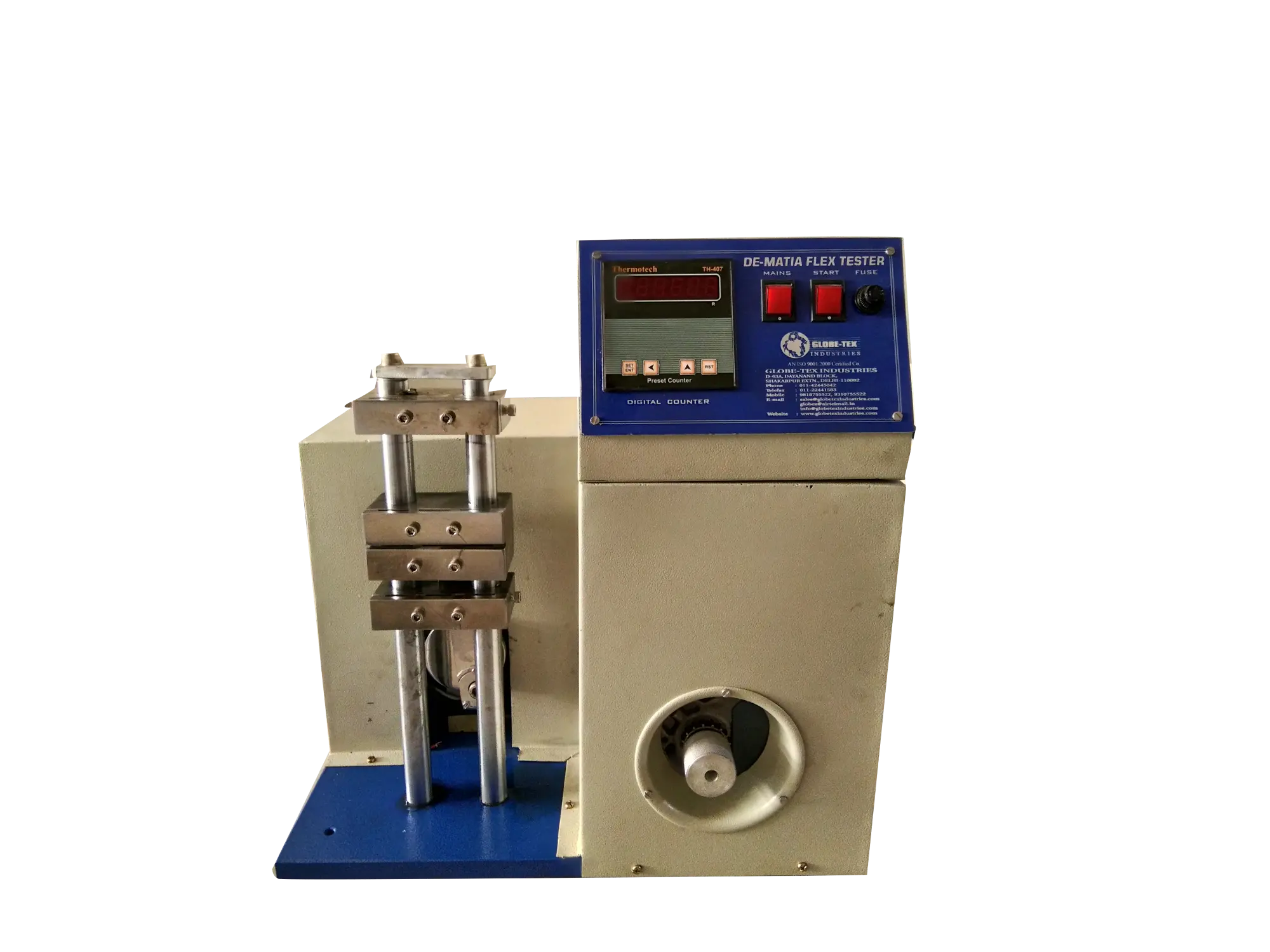
DE-MATTIA FLEX TESTER
| The apparatus consists of four station of flat grips of each pair being positioned vertically above the other. One of the grips of each pair shall be capable of a reciprocating motion in a vertical plane the rate of movement of the reciprocating grip being 5.0 + 0.2 Hz. Each pair of grips are so positioned that they are 70+1 mm apart when in the open position and 12.5 + 0.5 mm apart when in the closed position.
The specimen shall be taken from the selvedge and at least 1 m from the beginning or end of the piece. The sample should be cut in a way that it gives the maximum representation of the fabric to be tested. The standard specimen should be a rectangular one about 125 mm long and 37.5 + 1 mm wide. In every series of test, cut six test specimens, three parallel to the longitudinal direction and three parallel to the transverse direction. Please note that there is no test pieces contain the same threads of fabric in the direction to be tested. |
 Chat on WhatsApp
Description
De-Mattia Flex Tester
The De-Mattia Flex Tester is used for evaluating the flexing behaviour of fabric specimens under controlled reciprocating movement. The apparatus consists of four stations, with each station having a pair of flat grips positioned vertically above one another.
One grip in each pair moves in a reciprocating motion in a vertical plane. The test arrangement allows fabric specimens to be subjected to repeated flexing under specified conditions.
The GTX-DM7 has a flexing frequency of 300 ± 10 cycles/minute and an angle of oscillation of 57.15 ± 0.1°.
Working Principle of De-Mattia Flex Tester
Each test station consists of two flat grips. One grip is capable of reciprocating movement while the other remains positioned opposite it.
The grips move between their specified positions during the flexing cycle, subjecting the fabric specimen to repeated flexing. The test specimens are prepared from the fabric according to the specified dimensions and testing direction.
Test Specimen of De-Mattia Flex Tester
The standard test specimen is rectangular and measures:
125 × 37.5 mm
For each series of testing, six specimens are prepared:
- Three specimens parallel to the longitudinal direction
- Three specimens parallel to the transverse direction
The specimens should be selected to provide a representative sample of the fabric being tested.
| Specification | Details |
|---|---|
| Model No. | GTX-DM7 |
| Number of Stations | 4 |
| Angle of Oscillation of Grips | 57.15 ± 0.1° |
| Flexing Frequency | 300 ± 10 Cycles/Minute |
| Maximum Distance Between Opposite Grips | 75 ± 2 mm |
| Dimensions of Test Specimen | 125 × 37.5 mm |
| Related Standard | IS 7016 Part-IV |
Features of De-Mattia Flex Tester
- Four test stations.
- Flat grips for holding fabric specimens.
- Reciprocating grip movement.
- Flexing frequency of 300 ± 10 cycles/minute.
- Grip oscillation angle of 57.15 ± 0.1°.
- Maximum distance between opposite grips: 75 ± 2 mm.
- Suitable for specimens measuring 125 × 37.5 mm.
or other textile laboratory testing solutions, explore our Fabric Testing Equipment range.
https://globetexindustries.com/product-category/fabric-testing-equipments/
The tester is specified with IS 7016 Part-IV as the related testing standard.
https://www.bis.gov.in/?lang=hi
Frequently Asked Questions
What is a De-Mattia Flex Tester used for?
It is used for evaluating the flexing behaviour of fabric specimens under controlled repeated movement.
How many stations does the GTX-DM7 have?
The tester has 4 test stations.
What is the flexing frequency?
The specified flexing frequency is 300 ± 10 cycles/minute.
What is the specimen size?
The specified test specimen dimensions are 125 × 37.5 mm.
What is the grip oscillation angle?
The angle of oscillation of the grips is 57.15 ± 0.1°.
How many specimens are prepared for a test series?
The described test procedure specifies six specimens, with three taken parallel to the longitudinal direction and three parallel to the transverse direction.
Which standard is associated with the tester?
The provided technical specification lists IS 7016 Part-IV as the related standard.